Why rents will just keep running higher.
How long until rents stop going up?
15-years, in the best case scenario. It’s the best case, but unlikely.
Rents are up 40% on where they were pre-Covid.
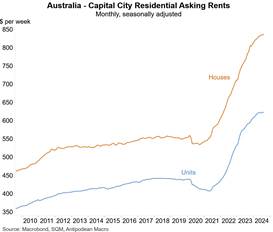
That has pushed rental affordability to its limits. Rental households now spend a third of their income on rents:

But it’s not getting better anytime soon.
That’s the word from Tim Gurner – celebrity high-rise developer. I forget what he was famous for now. Being good looking?

But reckons the rental shortage has at least 15 years to run:
“Even if the government came out tomorrow and changed all the planning rules, changed all the capital and debt rules, it’s not going to be fixed in three, not fixed in five, seven or 10 [years],” Gurner, one the country’s biggest apartment developers, told The Australian Financial Review.
“We have a good five to 15 years’ worth of rental crisis coming where there’s going to be a huge amount of pressure on supply.”
“If you look at the vacancy rates, it’s pretty simple, right? We have vacancy around 1 per cent in every single state, construction supply is the lowest it’s been in 10 years.
“Population growth is higher than it’s ever been. So it’s very simple mathematics to see that we’ve got the biggest undersupply in history with the highest demand in history, with population growth still growing. So it’s got nothing to do with our motivations.”
He’s not wrong.
We like to pretend that the housing market is complex. But more often than not the maths is pretty simple.
But where Gurner is right on the money is on the reason why new supply is not coming to market.
People like to complain about red tape, or green tape, or NIMBYs or councils, but the simple truth of it is that the numbers just don’t stack up right now.
Gurner said the biggest problem for developers was high construction costs. Developers will not build if they cannot make a profit.
“Us as developers, really, we take a cost base. We put a margin and the cost is what it is,” he said. “It’s never been harder to actually bring supply to the market.
“If the government wants to bring in more affordable and more attainable housing, they have to find a way to increase supply which allows us to drop our cost. It’s the only way to do it.”
He doesn’t say how governments should do that… I’m not even sure what they could do… nationalise the supply chain? Provide zero-interest loans?
But the simple fact is that there’s a viability gap right now – a difference between what a project costs and what it can sell for.
And until that closes, we just won’t be able to bring much stock to market.
15-years really is the best-case scenario.
JG.
The quickest method of increasing dwelling supply is to build more apartments.
But most renters don’t want to live in these dwellings and they are generally not good investments for investors due to high expenses and low capital growth.
They are also the most expensive form of dwelling construction.
You asked what the government can do to Increase supply?
They can incentivise purchasers by reducing or removing stamp-duty on off the plan contracts. That would assist developers achieving their pre-sales required to obtain construction finance.
They can also give back some of the gravy train that flows from Property to government coffers …
….more than 40% of a new apartment build cost goes to one the three levels of government that all have their nose in the trough .
The Constant change to environmental standards and building codes added to the long delays to obtain approvals and the reluctance of all local councils to allow higher density dwelling in their suburbs all adds to time it takes to deliver a new dwelling and drives up the cost
Governments can’t complain about developers not providing affordable housing, when so much of government revenue comes from the Property sector which is the major factor inflating the cost of housing.!!